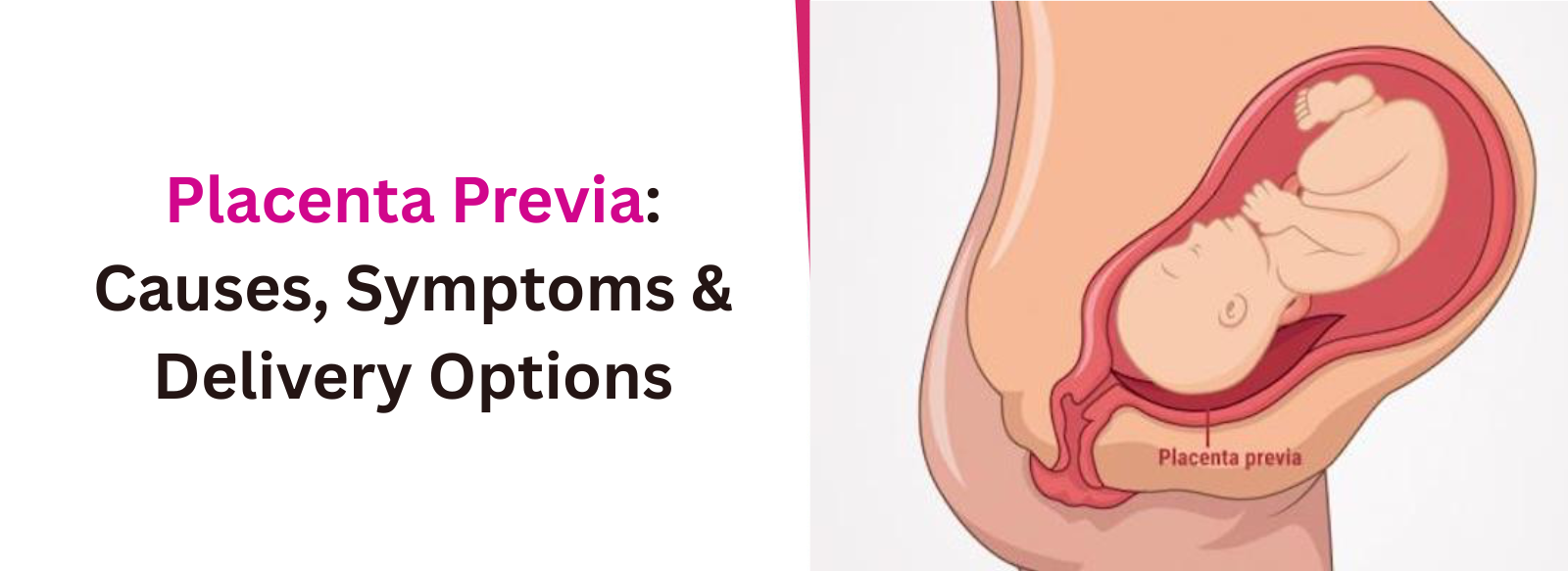
Placenta previa is a pregnancy condition in which the placenta grows too low in the uterus and partially or completely covers the cervix, the opening of the womb. Since the cervix is the passage through which the baby is delivered, placenta previa can cause serious complications such as bleeding during pregnancy and delivery.
Many women search for placenta previa causes, placenta previa symptoms, and placenta previa treatment after experiencing unusual bleeding during pregnancy. Early diagnosis and proper medical care are important to protect both mother and baby.
Placenta previa affects around 1 in 200–500 pregnancies and is slightly more common in IVF pregnancies. With regular monitoring and expert care, most women with placenta previa can have a safe pregnancy and delivery.
Types of Placenta Previa
Doctors classify placenta previa depending on how much of the cervix is covered by the placenta.
Marginal Placenta Previa
The placenta lies close to the cervix but does not completely cover it. This is also called a low-lying placenta.
Partial Placenta Previa
In partial placenta previa, the placenta covers part of the cervical opening.
Complete Placenta Previa
Complete placenta previa occurs when the placenta fully covers the cervix. In most cases, cesarean delivery is necessary for safe childbirth.
Early diagnosis helps doctors decide the safest treatment and delivery plan.
Placenta Previa Causes
The exact placenta previa causes are not always known, but several factors may increase the risk of developing this condition.
Common Placenta Previa Risk Factors
Previous cesarean section (C-section)
Previous uterine surgery
IVF pregnancy
Smoking during pregnancy
Multiple pregnancies
Pregnancy after age 35
History of placenta previa
Dilation and curettage (D&C)
Cocaine or recreational drug use
Women with these risk factors should attend regular prenatal checkups and ultrasound scans.
Placenta Previa Symptoms
The most common placenta previa symptom is painless bright red vaginal bleeding during the second half of pregnancy.
Common Symptoms Include:
Bright red vaginal bleeding after 20 weeks
Bleeding after intercourse
Bleeding after medical examination
Mild abdominal cramps
Repeated spotting during pregnancy
Contractions or pelvic pressure
Many women also search for “bright red spotting 32 weeks pregnant,” which may sometimes be related to placenta previa and requires immediate medical attention.
Placenta Previa Diagnosis
Placenta previa is usually diagnosed during routine ultrasound scans.
Diagnostic Methods
Routine pregnancy ultrasound
Transvaginal ultrasound
Repeat ultrasound scans for monitoring
In many cases, the placenta moves upward naturally as pregnancy progresses.
Can Placenta Previa Resolve Naturally?
Yes, many cases of low-lying placenta diagnosed early in pregnancy improve naturally as the uterus grows.
However, complete placenta previa usually requires close monitoring and planned cesarean delivery.
Placenta Previa Treatment Options
Placenta previa treatment depends on:
Amount of bleeding
Placental position
Pregnancy stage
Mother and baby’s condition
Mild Cases
Doctors may recommend:
Bed rest
Reduced physical activity
Avoiding intercourse
Regular monitoring
Avoiding heavy lifting
Severe Cases
Heavy bleeding may require:
Hospitalization
Blood transfusion
Emergency cesarean section
Intensive monitoring
Doctors may also give steroid injections to help the baby’s lungs mature if early delivery becomes necessary.
Placenta Previa Delivery Options
Planned Cesarean Delivery
Most women with placenta previa require a planned C-section around 36–37 weeks.
Emergency C-Section
Emergency surgery may be needed if severe bleeding starts suddenly.
Vaginal Delivery
Rarely possible in minor low-lying placenta cases under strict medical supervision.
Placenta Previa Complications
If not managed properly, placenta previa can cause complications for both mother and baby.
Maternal Complications
Heavy bleeding
Severe anemia
Hemorrhagic shock
ICU admission
Blood transfusion
Hysterectomy in severe cases
Baby-Related Complications
Premature birth
Low birth weight
Breathing problems
NICU admission
Growth restriction
Early diagnosis and proper medical care greatly improve outcomes.
Placenta Previa Prevention Tips
Placenta previa cannot always be prevented, but healthy pregnancy habits may lower complications.
Helpful Tips
Avoid smoking and alcohol
Attend regular prenatal checkups
Get timely ultrasound scans
Follow doctor instructions carefully
Seek immediate medical care if bleeding occurs
Women with IVF pregnancies should maintain regular monitoring throughout pregnancy.
Placenta Previa in IVF Pregnancy
Women who conceive through IVF treatment may have a slightly higher chance of developing placenta previa.
At Vardaan IVF Center, experienced specialists provide:
Advanced pregnancy monitoring
High-risk pregnancy care
Personalized IVF pregnancy support
Expert obstetric management
With proper monitoring and expert care, most IVF mothers with placenta previa experience safe pregnancies and healthy deliveries.
Frequently Asked Questions
What is placenta previa?
Placenta previa is a pregnancy condition where the placenta partially or completely covers the cervix.
What are the main placenta previa causes?
Common causes include previous C-section, IVF pregnancy, uterine surgery, smoking, and advanced maternal age.
What are placenta previa symptoms?
The most common symptom is painless bright red vaginal bleeding after 20 weeks of pregnancy.
Can placenta previa resolve naturally?
Yes, many low-lying placenta cases improve naturally during pregnancy.
Is vaginal delivery possible with placenta previa?
Most women with placenta previa require cesarean delivery for safety.
Does placenta previa affect the baby?
Yes, placenta previa may increase the risk of premature birth and low birth weight.
Final Thoughts
Placenta previa is a serious pregnancy condition where the placenta covers part or all of the cervix, increasing the risk of bleeding and delivery complications. Understanding placenta previa symptoms, causes, treatment options, and pregnancy risks helps mothers seek timely medical care and reduce complications.
With proper prenatal monitoring, ultrasound diagnosis, and expert medical support, most women with placenta previa can have safe pregnancies and healthy babies.
At Vardaan IVF Center, our experienced fertility and pregnancy specialists provide advanced care and personalized support for women experiencing placenta previa and other high-risk pregnancy conditions.